
| What is the Age Range of pupils at BGLC | 11 to 18 years |
|---|---|
| Special Educational Needs Coordinator (SENDCo) | Mrs V Varney |
| Academy Councillor with responsibility for SEND | Mrs Helen Stockhill |
| Contact Information | [email protected] |
| Local Offer Webpage Link |
https://www.leicestershire.gov.uk/education-and-children/special-educational-needs-and-disability |
[/fusion_table]
AIM OF THE LEARNING SUPPORT TEAMS
At the Brookvale Groby Learning Campus we strive to ensure that all students receive a high quality and ambitious education. We believe that it is vital that our students are equipped with the tools needed to become independent, inquisitive learners, both in and out of the classroom. Some Students in our school have special education needs and will require additional support in order to access the curriculum .
We value students’ personal qualities, afford equal value to all members of the school community, and encourage students to develop a sense of moral value. The Learning Support Team’s vision and ethos is to adopt a “student centred approach” where a young person’s aspirations and views are at the core of planning their learning journey.
Parents and students can expect to work collaboratively with the Learning Support Teams to ensure a smooth transition between the key stages.
We are guided by the Code of Practice for Special Educational Needs (2015) and the Equality Act (2010) which recognise that “students with special educational needs have learning difficulties that are significantly greater than the majority of children of the same age or have disabilities that prevent or hinder them from having full access to the facilities or curriculum.”
There is a need to ensure that there is appropriate challenge in the learning of all our students, by developing the range of strategies for differentiated learning in the classroom.
For some students, needs will be long term and go across phases from primary school to post sixteen. For others, needs will be short term or temporary, perhaps the result of emotional or physical crisis. Some of these students will have an Educational Health Care Plan or a SEND support plan.
The SEND Team is responsible for:
- Coordinating the provision for children with SEND and creating opportunities that allow them to access the curriculum in a safe and inclusive way
- Developing and reviewing the SEND policy
- The day to day management of the support for children with SEND.
- Giving the responsibility to Teachers, TAs and LSAs for educational provision, but still having responsibility for ensuring that your child’s needs are met
- Ensuring that parents are:
– Involved in supporting their child’s learning
– Kept informed about the support their child is receiving
– Involved in reviewing how their child is doing
– Part of the planning ahead for their child
- Supporting successful transitions – whether this is between key stages or to external provisions
- Liaising with external agencies who can offer advice and support to school, students and parents
- Providing specialist advice and facilitating training to ensure that all staff in school are skilled and confident about meeting the wide range of SEND needs
- Developing appropriate interventions
- Ensuring appropriate access for exams
The SENDCo is supported by an Assistant SENDCo, a SEND administrator and a team of experienced Teaching Assistants and Learning Support Assistants; they provide the academic and personal support for students with SEND. Teaching Assistants and Learning Support Assistants may be allocated to a group of students or on a more individualised basis depending on the students’ needs.
If you have any questions about SEND at BGLC, please do not hesitate to contact our Campus SENCo:
| Communication and Interaction (e.g. speech articulation, stammering, speech and language delay, autism etc) | Outside Agencies | In school intervention |
| Children and young people with speech, language and communication needs (SLCN) have difficulty in communicating with others.
This may be because they have difficulty saying what they want to, understanding what is being said to them or they do not understand or use social rules of communication. The profile for every child with SLCN is different and their needs may change over time. They may have difficulty with one, some or all of the different aspects of speech, language or social communication at different times of their lives. Children and young people with ASD are likely to have particular difficulties with social interaction. They may also experience difficulties with language, communication and imagination, which can impact on how they relate to others. Members of the inclusion faculty and full staff team have training in ASD and SLCN. |
The Speech and Language Therapists work with individual scholars from their caseload.
Advice is provided and shared with staff. The CLCI ASD link teachers work with individuals and provide specific advice for school. The Educational Psychologist provides advice and strategies for individual scholars. Enhanced transition arrangements ensure needs are identified and arrangements put in place as scholars move from KS2. Training for whole school staff.
|
High quality teaching is in place in all areas of the curriculum.
Individual Scholar passports with strategies shared from outside professionals. An allocated Key worker to deliver interventions, adapt passport, communicate with parents and input as directed by specialists. Bespoke individual support is available if professionals advise this is necessary. Personalised support and guidance where necessary. Lunchtime nurture groups for both year groups to provide routines and support for social interaction. Lego therapy sessions in place to support social skills. Use of appropriate ICT to reinforce skills Scholar’s baselines and subsequent progress accurately monitored and provision regularly reviewed and adjusted in line with their progress.
|
| Cognition and Learning (e.g. global learning difficulties, dyslexia, dyscalculia etc) | Outside Agencies | In school intervention |
| A young person has a learning difficulty or disability if they have significantly greater difficulty in learning than the majority of others of the same age, or has a disability which prevents or hinders them from making use of facilities of a kind generally provided for others of the same age in mainstream schools.
Support for learning difficulties may be required for children and young people learn at a slower pace than their peers, even with appropriate differentiation. Learning difficulties cover a wide range of needs, including moderate learning difficulties (MLD) or specific learning difficulties (SpLD). On entry, the school assesses scholars’ cognition and learning through MIDYIS tests, literacy tests are conducted and previous attainment levels at KS2 are reviewed. If any concerns are raised then further assessments and advice is sought. These assessments might identify moderate learning difficulties (MLD) or specific learning difficulties (SpLD), which affects one or more specific aspects of learning. This encompasses a range of conditions such as dyslexia, dyscalculia and dyspraxia. |
Complex Learning, Communication and
Interaction Support Team (CLCI) provide advice and guidance with assessments, suggesting and implementing programmes to meet individual needs. Educational Psychologists support with assessments, suggest and implement appropriate programmes. Primary school links take place during transition and throughout the academic year when necessary. Support in transition plans to post 16 provision where appropriate. LCI team referrals where appropriate. College representatives attend transition meeting when appropriate. Where appropriate, agencies submit reports for reviews and attend them. |
High quality teaching is in place in all areas of the curriculum.
Individual Scholar passports with strategies shared from outside professionals. An allocated Key worker to deliver interventions, adapt passport, communicate with parents and input as directed by specialists. The following programmes are implemented when baseline assessments indicate a need: • Variety of reading interventions targeted to particular aspects of literacy and reading including: Inference, Spelling, Handwriting interventions and Writing development • Targeted Maths interventions Small group and individual work where appropriate The following assessments are used in conjunction with observation to identify specific needs: • MIDYIS • Spelling and reading age assessments • Dyslexia checklist with online literacy assessments. Individual/small group programmes reinforced by appropriate ICT for language, literacy and numeracy skills. Pre-teaching and reinforcing curriculum learning. Alternative provision is sought where necessary including bespoke programmes. Lunchtime and afterschool study clubs to support learning. Scholar’s baselines and subsequent progress accurately monitored and provision regularly reviewed and adjusted in line with their progress.
|
| Social, mental and emotional health SEMH (e.g. anxiety, depression, eating disorders, obsessive, compulsive disorder (OCD) etc. | Outside Agencies | In school intervention |
| Young people may experience a wide range of social and emotional difficulties which manifest themselves in many ways. These may include becoming withdrawn or isolated, as well as displaying challenging, disruptive or disturbing behaviour.
These behaviours may reflect underlying mental health difficulties such as anxiety or depression, self-harming, substance misuse, eating disorders or physical symptoms that are medically unexplained. Other children and young people may have disorders such as attention deficit disorder, attention deficit hyperactive disorder or attachment disorder. The school assesses scholars’ emotional and behavioural needs to ensure appropriate interventions are initiated and opportunities to address any issues identified. We have good links with feeder primary schools, and the year 6 profiles are shared before transition and enhanced induction days and personalised transition arrangements for KS2-3. Safeguarding, anti-bullying and behaviour policies and procedures all support scholars with SEMH needs. |
The following agencies may be requested to contribute to further assessments and programmes of support:
School Counsellor School Nurse/GP Educational Psychology Service Child & Adolescent Mental Health Service (CAMHS) ADHD solutions Secondary Behaviour Support services and teams Youth Offending Team Trust SEMH specialist- Sophie Tales For those children who are unwell and not able to attend mainstream school, the Children’s Hospital School may be involved and they may be educated offsite. Transition at each Key Stage will involve past or future educators and Careers input when appropriate.
|
High quality teaching is in place in all areas of the curriculum.
Individual Scholar passports with strategies shared from outside professionals. An allocated Key worker to deliver interventions, adapt passport, communicate with parents and input as directed by specialists. The following resources are used to support those children who have been identified with issues relating to SEMH difficulties: Key workers are available to provide support, guidance, modelling and practice of skills if appropriate. Close networking of the pastoral care team and inclusion team allow for SEMH interventions to be delivered. Individual support provided from the trust SEMH primary intervention lead Sophie Tales. Where necessary safe spaces are available for scholars in crisis. Where necessary Scholars are referred for counselling to support which issues that may be affecting their SEMH. Planned tutor time curriculum allows for tutors to provide one to one intervention where necessary. PSHE curriculum includes a focus on positive relationships, anti-bullying, safety, identity and other areas essential to all scholars development. Scholars have access to prep time each week with their tutor where tutoring and check in’s take place. Bereavement support is offered and referrals to the Laura Centre if appropriate. Scholar’s baselines and subsequent progress accurately monitored and provision regularly reviewed and adjusted in line with their progress. |
| Sensory/ Physical (Visual impairment, hearing impairment, sensory needs (e.g. autism, dyspraxia, toileting issues, physical disability etc) | Outside Agencies | In school intervention |
| Some children and young people require special educational provision because they have a disability, which prevents or hinders them from making use of the educational facilities generally provided.
These difficulties can be age related and may fluctuate over time. Many children and young people with vision impairment (VI), hearing impairment (HI) or a multi-sensory impairment (MSI) will require specialist support and/or equipment to access their learning, or habilitation support. Children and young people with an MSI have a combination of vision and hearing difficulties. Young people with a physical disability (PD) require additional ongoing support and equipment to access all the opportunities available to their peers. A range of teaching and learning resources are used to take into account different learning styles and to compensate for reduced sensory or physical abilities. Clear planning for the production of modified resources, with support from outside agencies where appropriate. Provision of differentiated and assistive resources and materials when planning delivery of lessons. Consideration of timetabling and location of rooms, which are suitably furnished. DDA compliant building, including where appropriate adaptations to the environment. The young person is aware of their own impairment and its limitations and implications for their own learning.
|
Specialist staff from the Hearing Support Team and Vision Support Team provides assessment and support where appropriate.
Physiotherapy and occupational therapy are fully involved when a child’s need merits this. Links with disability sports provide help with inclusive practices. Enhanced transition arrangements ensure needs are identified and arrangements put in place as scholars move from KS2. Other agencies are involved if appropriate.
|
High quality teaching is in place in all areas of the curriculum.
Individual Scholar passports with strategies shared from outside professionals. An allocated Key worker to deliver interventions, adapt passport, communicate with parents and input as directed by specialists. All environmental aspects of the school building have been considered with reference to special individual needs, and where appropriate, modifications are provided after support and guidance from appropriate agencies. Consideration of timetabling and location of rooms for those with sensory needs. The following are available to scholars with these needs: · Disabled toilets · Fire evacuation · Adapted resources for ICT
Scholar’s baselines and subsequent progress accurately monitored and provision regularly reviewed and adjusted in line with their progress. |
How does BGLC Brook Mead adapt the curriculum and the learning environment of pupils with SEND?
BGLC has a highly effective centrally planned curriculum that is adapted to suit each teaching group by the classroom teacher. Our teaching and learning framework ensures all scholars are equipped and empowered.
All departments outline the way they will develop and adapt the curriculum, so it is coherently sequenced for all SEND scholars’ needs, starting points but still offers the same entitlement to powerful knowledge. All curriculum areas ensure that the One Page Profiles are referenced, and strategies developed and used in lessons, this is supported by the inclusion team who observe and offer feedback for the students.
What steps are taken to prevent pupils with SEND from being treated less favourably than other pupils?
At BGLC we believe everyone if capable of excellence, we develop the whole self, we make no excuses, so a diagnosed or undiagnosed need does not entitle scholars to be treated differently, we see feedback a gift.
Our coaching model allows staff to continuously develop and reflect on their practice to become to best practitioners for all students
How will BGLC evaluate the effectiveness of the provision made for pupils with SEN?
The progress of scholars is accessed ongoing through interventions and at the end of each cycle, Data meetings are attended by the Principal, Curriculum Leaders and the SENDCo to scrutinise progress and actively adapt provision if necessary. Line management meetings allow Curriculum Leaders to evaluate the effectiveness of provision ongoing through challenging conversations and a sequenced culture of critique.
How does BGLC assess and review pupil’s progress towards outcomes?
Whole school assessments and data drops allow us to identify if scholars are positively progressing. In addition to these interventions include assessment processes to identify where scholars are positively progressing towards individual outcomes.
What support for improving emotional and social development does Brook Mead offer?
We have a trained and experienced pastoral and SEND team of staff who will support with social and emotional development. Teachers also have training and a wide body of experience and expertise to draw upon.
How does Brook Mead involve other bodies, including health and social care bodies, local authority support services and voluntary sector organisations, in meeting pupil’s SEN and supporting their families?
We have strong multi-agency working and safeguarding, ensuring that we receive the most appropriate support from external agencies. Brook Mead Academy works in partnership with other agencies in order to provide an integrated support based on the needs of the scholar. The main external support agencies used by the Academy include (this is not an exhaustive list):
- The Educational Psychologist
- CAMHS support
- Learning, Communication and Interaction team (LCI)
- Children’s Hospital School
- School Nurse
- School counsellor
- Educational Welare Officer
- Speech and Language Service
- Occupational Therapy
How does Brook Mead support pupils with SEND in the transfer between phases of education/the preparation for adulthood and independent living?
We will have strong transition arrangements for post 16 provision including enhanced visits during Year 11 reviews after transition, resulting in no NEET students and a well-established programme of transition from feeder primary schools.
How are scholars with SEND supported in the event of remote or blended learning?
During a period of remote or blended learning every EHCP or high needs student will be allocated a teaching assistant who will keep in regular contact with them whilst they are working from home. They will provide regular telephone or Teams support for both emotional wellbeing and support to access and complete on-line lessons.
What are the arrangements for handling complaints from parents of children with SEN about the provision made at BGLC?
We would like to think that the relationship we aim to establish with parents means that queries and concerns could be responded to informally by our SENDCO in the first instance. However, our Complaints Procedure is available to parents on the policies section of our website here.
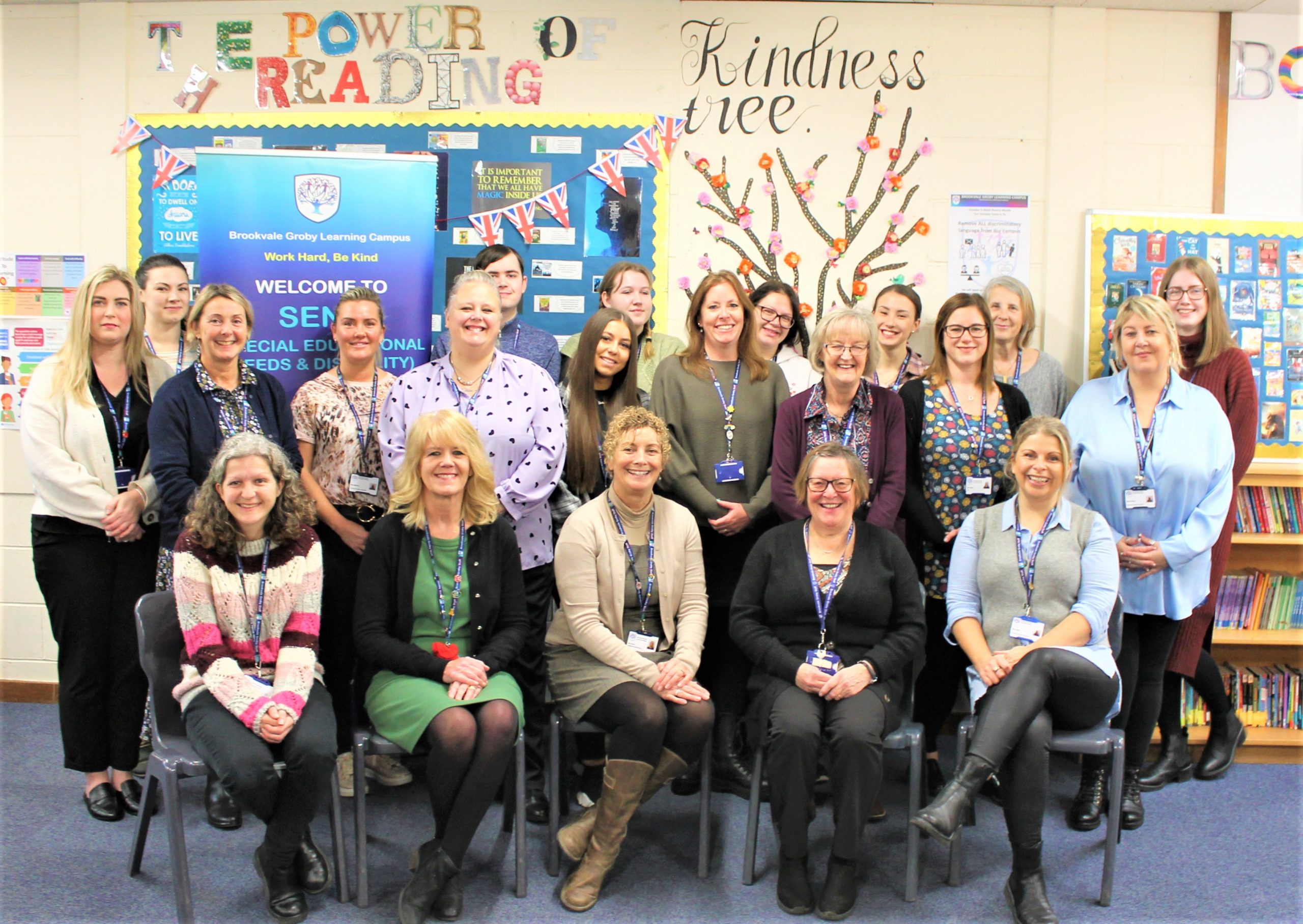
Meet the SEND team!
At Brookvale Groby Learning Campus (BGLC) we have a dedicated team of staff supporting the achievement, progress and well-being of our SEND students. Our team is led by SENCo Mrs Michelle Tointon, who is supported by Assistant SENCO Mrs Kay Pratt, Clare West SEND admin support and Mrs Michelle Dale Lead LSA. We work closely together with the pastoral team and all staff on the campus to ensure that our students are happy at school, make progress and achieve the best outcomes possible.
As a team, we are responsible for:
- Liaising with students and parents to plan for the best possible outcomes for our students both socially and academically
- Liaising with schools and outside agencies to ensure that we have an excellent knowledge of our students and their needs
- Planning, updating and implementing the SEND strategy across the campus
- Delivering appropriate training for all staff on the campus
- Tracking data and monitoring progress
- Planning, delivering and monitoring the impact of interventions
- Deploying the funding we receive in a way that most benefits our students
- Working with faculty leaders to ensure that the curriculum is accessible and differentiated appropriately to all
If you have any questions about SEND at BGLC, please do not hesitate to contact our Campus SENCo:
 Value Everyone, Achieving Excellence